
Haringey has a £5.93m hardship package for 2026/27, led by £2.2m for school holiday food. Its draft anti-poverty strategy is open for comment until 11 January.
Overview
Haringey Council will spend £5.93 million in 2026/27 helping residents in financial hardship. The largest sums are £2.2 million for children’s food in the school holidays and £1.4 million to help people pay rent and avoid homelessness. An expanded council phone advice line opens on 30 November, 9am to 5pm. Residents can comment on the council’s draft Anti-Poverty Strategy until Monday 11 January.
Haringey Council has set out how it will spend £5.93 million this year on residents struggling with money, and has opened its draft Anti-Poverty Strategy for comment. The council announced both on 23 November.
The money is the first year of Haringey’s £17.8 million share of the government’s Crisis and Resilience Fund. That fund runs for three years, from April 2026 to March 2029. It replaced the Household Support Fund in April.
Where the money goes
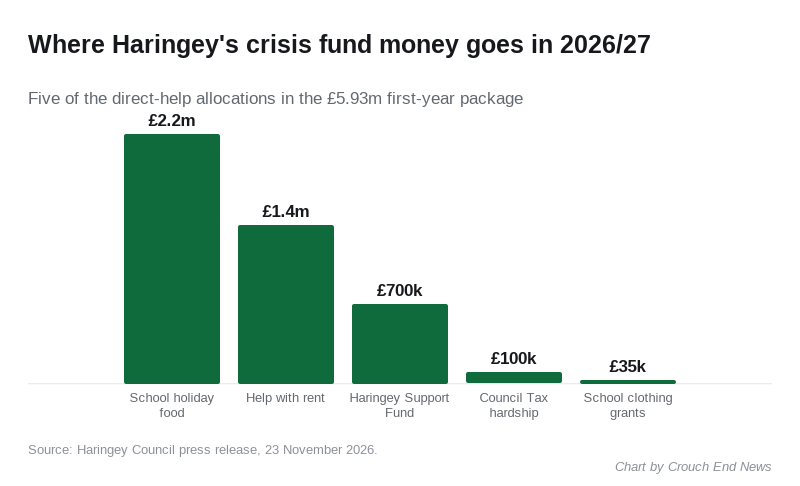
The council’s release lists these allocations for 2026/27:
- £2.2 million for school holiday food for children
- £1.4 million to help residents with rent, to prevent homelessness
- £700,000 for the Haringey Support Fund, the council’s crisis payment scheme
- £385,000 to help people into work or better work, including more job clubs and a new childcare support fund
- £100,000 for Council Tax hardship support
- £35,541 to keep Advice Connect running, the debt, welfare and housing advice service run by Citizens Advice Haringey and the Pro Bono Community
- £35,000 for school clothing grants
The housing support fund is up by 20%, or £238,400, the council said.
School holiday vouchers are changing
Families should note the change to holiday food support. Until December 2026, the council will pay £15 a week in the school holidays for every pupil who met the old free school meals rules.
From February 2027 the rules change. Vouchers rise to £30 a holiday week, but they go to pupils the council identifies as living below the poverty line. Schools will get an extra fund for families in hardship that the council’s data misses. Schools will also be able to refer families to the council’s Financial Support Team.
What the strategy says about the borough
The Cabinet agreed on 10 November to consult on the strategy. Its Cabinet paper sets out the scale of the problem:
- an estimated 26% of residents live below the poverty line, in line with London
- 39% of children live in poverty, against a London average of 31%
- unemployment rose from 4.5% to 7.2% in a year to July 2026, against 5.6% for London
- the average private rent reached £2,214 a month in April 2026, up 25% since March 2021
- 2,660 households are in temporary accommodation
Around half of residents in poverty are already in work, the paper says. It names low pay, insecure hours and high housing costs as the main causes.
Cllr Jo Kuper, Cabinet Member for Resident Services and Tackling Inequality, said: “Too many residents in Haringey are struggling with the cost-of-living crisis and impact of rising costs, so it is important that support is easy to find and easy to access.”
The council is also running a neighbourhood pilot in Northumberland Park, Tottenham. It will bring local groups and council services together in one place. Northumberland Park is London’s most deprived ward, according to the Cabinet paper.
What it means for you
- If you are struggling now, the council’s Here to Help pages list the support on offer, including the Haringey Support Fund.
- From 30 November, an expanded phone advice service offers financial advice from 9am to 5pm, the council said.
- To comment on the strategy, use the Anti-Poverty Strategy consultation before Monday 11 January. Paper surveys are available at the Customer Centre in Wood Green Library, from Citizens Advice Haringey, or by calling 020 8489 4431.
The council plans to review responses in January and February. Cabinet is due to decide on the final strategy in March 2027, according to the consultation timeline.
Have your say