
Haringey band D is £2,313.78 this year, up £105.84. The full A to H table, what the 4.99% rise pays for, and the £29 error in the council's band F row.
Crouch End pays Haringey Council. There is no parish or town council here, so a bill has two parts and only two: Haringey’s charge and the Greater London Authority precept.
Band D this year is £2,313.78. Here is the whole table, where the money goes, and a mistake on the council’s own page worth knowing about.
Every band, 2026/27
| Band | 1991 value | Haringey | GLA | Total |
|---|---|---|---|---|
| A | Up to £40,000 | £1,202.18 | £340.34 | £1,542.52 |
| B | £40,001 to £52,000 | £1,402.55 | £397.06 | £1,799.61 |
| C | £52,001 to £68,000 | £1,602.91 | £453.79 | £2,056.70 |
| D | £68,001 to £88,000 | £1,803.27 | £510.51 | £2,313.78 |
| E | £88,001 to £120,000 | £2,204.00 | £623.96 | £2,827.96 |
| F | £120,001 to £160,000 | £2,604.73 | £737.40 | £3,342.13 |
| G | £160,001 to £320,000 | £3,005.45 | £850.85 | £3,856.30 |
| H | Over £320,000 | £3,606.55 | £1,021.02 | £4,627.57 |
Source: Haringey’s find your council tax band page. Every band is worked out from band D, so if you know band D you can derive the rest.
The band F row on the council’s page is wrong
If you are in band F, ignore the GLA column on the council’s own table. It prints £708.33. That is last year’s figure.
The correct 2026/27 GLA charge for band F is £737.40, and it is set out in table 5 of the budget report Cabinet approved on 10 February 2026. The gap is £29.07.
The good news is that the total in the right-hand column, £3,342.13, is correct. Only the GLA cell that feeds it is stale, so a band F bill is not affected. It is the working that is wrong, not the answer.
What went up, and by how much
Two separate decisions land on the same bill.
Haringey put its own charge up 4.99%. That is the maximum allowed without a referendum, and it is made of a 2.99% general increase plus a 2% adult social care precept. Band D went from £1,717.56 to £1,803.26, an increase of £85.70.
The GLA put its precept up 4%, or £20.13 at band D, from £490.38 to £510.51. The Mayor’s share breaks down like this:
| 2025/26 | 2026/27 | |
|---|---|---|
| Metropolitan Police (MOPAC) | £319.13 | £334.13 |
| London Fire Brigade | £71.72 | £76.85 |
| Greater London Authority | £22.44 | £22.44 |
| Transport for London | £77.09 | £77.09 |
| Total | £490.38 | £510.51 |
The GLA and TfL elements did not move at all. The whole increase is police and fire, and the council’s GLA page attributes it to phone theft enforcement and to inflation pressure on the fire brigade.
Put together, a band D bill went from £2,207.94 to £2,313.78. That is £105.84 more, or 4.8%.
Most Haringey homes are not band D
Band D is the national yardstick, and in Haringey it is not the average. The council says so plainly in its own budget report: “In most areas, Band D is the average but for Haringey, the average remains as Band C.”
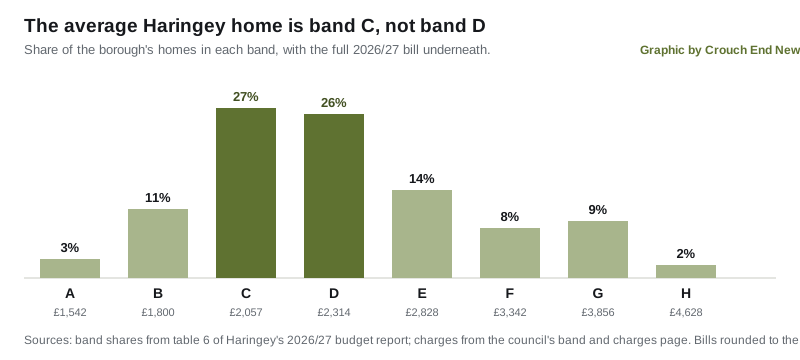
| Band | Share of Haringey homes | Total bill |
|---|---|---|
| A | 3% | £1,542.52 |
| B | 11% | £1,799.61 |
| C | 27% | £2,056.70 |
| D | 26% | £2,313.78 |
| E | 14% | £2,827.96 |
| F | 8% | £3,342.13 |
| G | 9% | £3,856.30 |
| H | 2% | £4,627.57 |
The band shares are from table 6 of the same budget report. It matters because government funding formulas use band D as the average, so a borough where the typical home is a band lower raises less per property than the formula assumes.
Crouch End sits at the higher end of that distribution, and Tottenham at the lower, but the council does not publish a band breakdown by ward.
Where the money goes
Haringey’s own budget and council tax guide for 2026/27 splits the £1,803.27 Haringey share of a band D bill:
| Per band D bill | |
|---|---|
| Adults, health and housing | £936.92 |
| Children’s services | £423.58 |
| Finance and resources | £182.17 |
| Culture, strategy and communities | £107.76 |
| Non-service budgets | £85.18 |
| Environment and resident experience | £67.66 |
More than half of it is adult social care, public health and homelessness. The bin collections, street cleaning, parks and highways that most people picture when they think of council tax account for £67.66 of a £1,803.27 bill.
Council tax funds 41% of what Haringey spends. The rest comes from business rates, government grants, income and borrowing.
The council expects to collect less of it
One number in the budget report is worth sitting with. Haringey has cut its assumed collection rate for 2026/27 to 92.50%, down from 95.75% the year before, because in-year collection is “tracking well below target thought to be due to residents feeling the on-going squeeze on income”.
Its council tax base fell with it, from 82,589 band D equivalents to 80,924.
Checking and challenging your band
Your band was set on what the property was worth in April 1991, not what it is worth now, which is why a flat converted since then can sit oddly against its neighbours.
- Look up any address on the VOA council tax band search.
- To challenge it, use the VOA’s guidance on how domestic properties are assessed. Haringey does not set bands and cannot change one.
A successful challenge can move the band down, but it can move it up as well, and it can move your neighbours’ too.
Discounts and reductions
- Single person: 25% off. Haringey is currently reviewing every account holding this discount. If a review letter arrives, you have 14 days to return the form. Miss it and the discount is removed and a revised bill issued.
- Students. A household where everyone is a full-time student pays nothing. With one non-student in the property there is a discount instead. You need a certificate from the college or university, and the course has to run at least a year at 21 hours a week for 24 weeks. Under-20s on courses over three months qualify separately. Details on the student exemptions page.
- Severely mentally impaired. A full exemption if everyone in the property qualifies, a discount if only some do. It needs a doctor’s certificate stamped by the practice, plus proof of a qualifying benefit. Full criteria here.
- Disabled band reduction. If the home has an extra room, an extra bathroom or kitchen, or wheelchair floor space needed by a disabled resident, you are charged at the band below. Band A properties still get a reduction. A stairlift, handrails, a walking frame or a Blue Badge do not qualify on their own.
- Low income. Haringey continues to fully fund its local Council Tax Reduction scheme. Just over 24,000 households receive it and the budget for it in 2026/27 is about £34.4m. There is also a Second Adult Reduction for people who share with non-paying adults on a combined income under £375 a week.
Empty homes and second homes cost more, not less
Haringey grants no discount at all on a second home. It charges a premium.
| Situation | Premium | You pay |
|---|---|---|
| Second home, furnished, no permanent resident | 100% | 200% |
| Empty and unfurnished under 1 year | none | 100% |
| Empty 1 to 5 years | 100% | 200% |
| Empty 5 to 10 years | 200% | 300% |
| Empty over 10 years | 300% | 400% |
Both premiums have applied since 1 April 2025. The empty premium is waived in a handful of cases, each listed on the empty properties and second homes page: a home actively marketed for sale or let, for up to 12 months; one undergoing major repairs, for up to 12 months; one awaiting occupation for 12 months after probate; an annexe treated as part of the main dwelling; and armed forces accommodation cases.
You cannot claim single person discount on an empty property or a second home.
Paying
Bills default to 10 instalments from April to January. You can ask to spread them over 12 instead, which lowers each payment without changing the total. Direct debit, online payment, online banking and phone payment are all set up through My Account.
Also on Crouch End News
- Crouch End bin collection days: the bank holiday rule, garden waste and bulky collections.
- Parking in Crouch End: CPZ hours, permit prices and the car park tariff.
- Crouch End roadworks and travel: what is dug up and until when.
Have your say