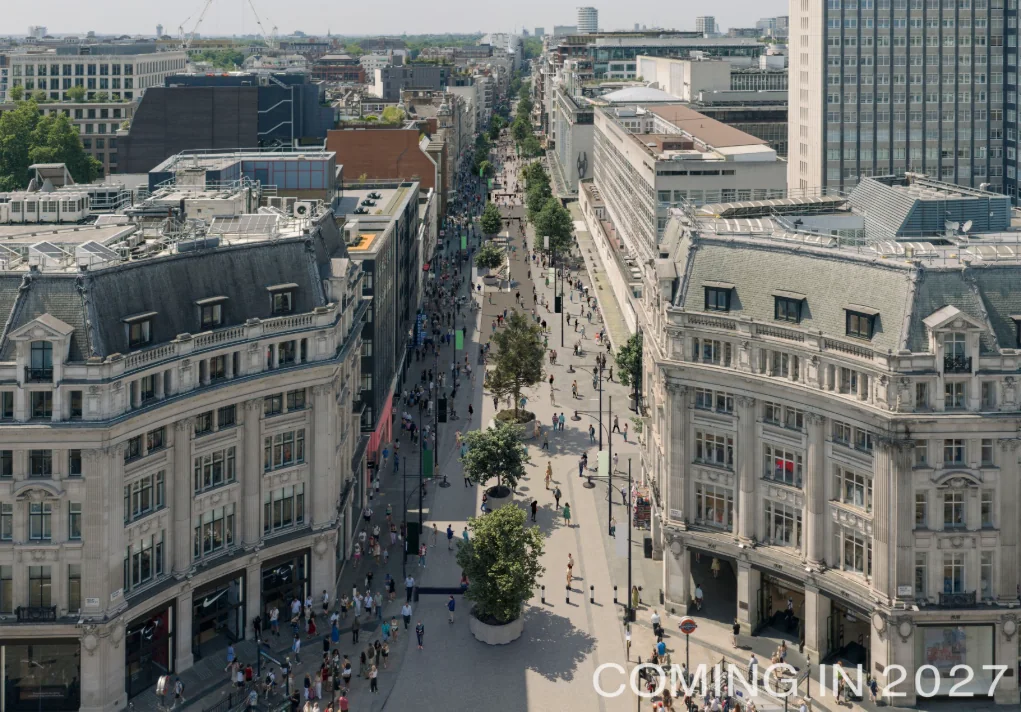

Footfall on traffic-free Oxford Street rose 16% and spending 28% in week one, City Hall says. The 390 from Archway now uses Wigmore Street, where speeds held.
Footfall on the traffic-free stretch of Oxford Street rose 16 per cent in its first week, and spending in its shops rose 28 per cent, according to figures released by the Mayor of London on Monday 9 November. Oxford Circus, the Victoria line stop that most Haringey shoppers use, recorded more people coming and going than before, and Transport for London says the buses rerouted around the closure, including the 390 from Archway, kept running well.
The section between Orchard Street and Great Portland Street has been shut to private vehicles, buses, taxis, private hire cars, cycles, scooters and pedicabs since Monday 26 October. When it closed we set out how to get there from Crouch End and the rest of Haringey, including where the 390 now stops.
What the first week showed
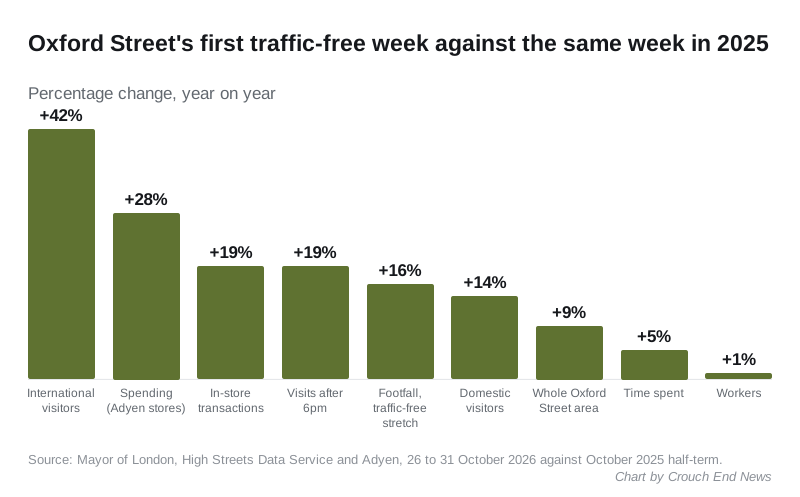
City Hall’s High Streets Data Service compared the first week, which fell in October half-term, with half-term week in 2025. On the pedestrianised section, City Hall says:
- footfall was up 16 per cent
- international visitors were up 42 per cent
- domestic visitors were up 14 per cent
- workers were up 1 per cent
- people stayed 5 per cent longer on average
Across the wider Oxford Street area it counted an average of 292,835 people a day between 26 and 31 October, up 9 per cent on the same days last year. Visits between 6pm and 6am were up 19 per cent.
City Hall says the figures “far surpass” the most optimistic expectations of the Mayor and the Oxford Street Development Corporation, both of which had expected a rise.
Oxford Circus and the Victoria line
Crouch End has no Tube station, so for most of our readers the trip in is the W7 or a walk to Finsbury Park, then the Victoria line to Oxford Circus. From Tottenham, Seven Sisters and Tottenham Hale it is the same line, direct.
TfL recorded more entries and exits at Oxford Circus and Bond Street in the first traffic-free week. Nearly 200,000 entries and exits a day were recorded from Wednesday 28 to Friday 30 October, it says, and Bond Street was up by more than 10 per cent from 28 October.
Its pavement counters showed the bigger jump. Just west of Oxford Circus, the average hourly count between 7am and 7pm on weekdays rose from 6,523 before the closure to 9,751 in the first week, up 49.5 per cent. At the Stratford Place and Davies Street junction by Bond Street station it rose from 5,516 to 8,051. TfL says footfall outside Bond Street station was up to 46 per cent above the average weekday count there between 7 September and 16 October.
That means a busier platform and a busier pavement at the top of the escalators than last Christmas, especially on weekday afternoons.
The 390 from Archway
The release does not break bus performance down by route. TfL says its contracted bus operators reported that services “continued to run well”, with disruption linked to short-term local incidents. It will use full route performance data, due in the coming weeks, to check scheduled running times and contracted performance standards.
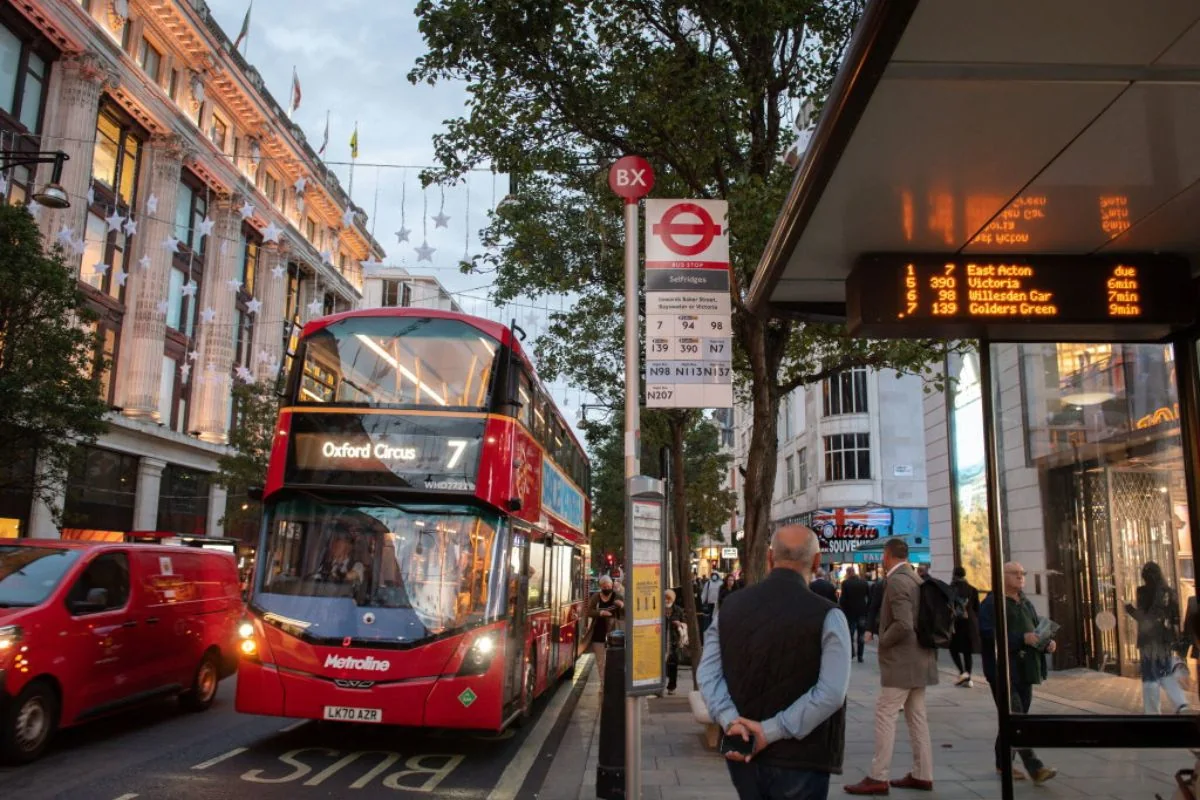
That matters for anyone who takes the 41 from Crouch End Broadway or the 134 from Muswell Hill and Highgate to Archway and changes onto the 390. The 390 no longer runs along Oxford Street: it was moved to Wigmore Street and Henrietta Place, as TfL’s stop guide shows.
On Wigmore Street, TfL found traffic speeds similar to before the closure, with eastbound journeys slightly faster and westbound journeys slightly slower. Early data also showed slightly faster journeys on Regent Street. Overall it found no significant change in speeds on the surrounding roads.
TfL says it considers the half-term figures representative, and will keep watching the road network and adjust traffic signals where needed as more people come in for Christmas.
What shops took
The spending figures come from the payments company Adyen and cover the Oxford Street stores in its year-on-year comparison. Spending rose from about £2.9 million to £3.7 million, and in-store transactions rose 19 per cent. The average spent per transaction went up from £100 to £107. On Regent Street, transactions rose by 1 per cent. Against the week before the closure, total spending rose 12 per cent, from £4.1 million to £4.6 million. Retail Week reported the Adyen figures.
Two businesses on the street gave their own numbers. Dan Hills, chief executive of Market Halls, said footfall at its Oxford Street food hall was up 29 per cent year on year and sales were up 25 per cent.
“Oxford Street has evolved far beyond a traditional shopping street, with hospitality, leisure and culture playing a vital role in its enduring appeal,” he said. “The increase in visitors coming through our doors, including a rise in the proportion of foot traffic from nearby Holles Street, shows that creating a more people-centric environment encourages people to explore more of what it has to offer and support local businesses.”
Paul Crossey, managing director of the Jane Austen Experience, said: “The pedestrianisation has meant more people are drawn to the attractions, shops and other businesses in and around Oxford Street. This increase has been measurable for us, as we saw 27 per cent more visitors to the Jane Austen Experience in the first week of the traffic-free scheme.”
What the Mayor and TfL said
Sadiq Khan said: “These are staggering early results that show the transformational impact that the pedestrianisation of Oxford Street will have. Our early work has been very warmly received by Londoners and visitors, with a surge in footfall and spend.”
“With Christmas around the corner, I’d encourage Londoners and visitors to come and see what a traffic-free Oxford Street has to offer, whether you’re here to shop, meet friends or make an evening of it.”
Claire Mann, TfL’s chief operating officer, said: “It may only be a few weeks since Oxford Street became traffic-free but already the feedback from people along the street has been phenomenal. A huge amount of work has gone into delivering this change, and as we continue to deliver further improvements to this new pedestrian space in the coming months, we will be closely monitoring these changes to make sure they are working for everyone and supporting the continued economic growth London needs.”
Nabeel Khan, chief executive of the Oxford Street Development Corporation, said: “We are greatly encouraged by the early footfall and dwell time figures, which is showing the additional space to roam is proving attractive to visitors to the street.”
Dee Corsi, chief executive of the New West End Company, struck a more cautious note. “We are about to enter the most important trading period of the year for the retail, hospitality and leisure sectors, and Christmas will be a crucial early test for pedestrianisation in practice,” she said. “Our focus remains on making sure Oxford Street is safe, clean, accessible and welcoming for visitors, while ensuring the practicalities work for West End businesses during the festive period.”
What happens next
City Hall says this is the first stage of a phased programme, and building work will be kept to a minimum in the coming weeks to limit disruption over Christmas. The figures cover a single week that was also half-term, so they are an early reading rather than a guide to a normal December.
What it means for you
- Going in from Crouch End: the W7 to Finsbury Park and the Victoria line to Oxford Circus is still the quickest way; our earlier piece has the journey times. Expect a busier street than last year, especially in the evening.
- Going by the 390: catch it on Wigmore Street or Henrietta Place, not on Oxford Street, and check the TfL journey planner before you leave.
- Shopping closer to home: our guide to Christmas shopping in Crouch End lists 20 local shops, and our Haringey Christmas travel page has the season’s rail and road changes.
Have your say