
The final draft of Haringey's Local Plan lifts the borough target to 21,535 homes but asks Crouch End, Hornsey, Muswell Hill, Highgate and Stroud Green for 1,250, not 1,500.
Haringey’s housing target is going up by more than a third, but the west of the borough is being asked for fewer homes than before. The final version of the new Local Plan goes to the council’s Cabinet on Tuesday 10 November.
The plan sets a minimum of 21,535 homes between 2026/27 and 2037/38. The 2025 draft said 15,920 over ten years. The council’s Cabinet report says the new figure covers twelve years and includes the backlog of homes the borough failed to deliver between 2021/22 and 2025/26.
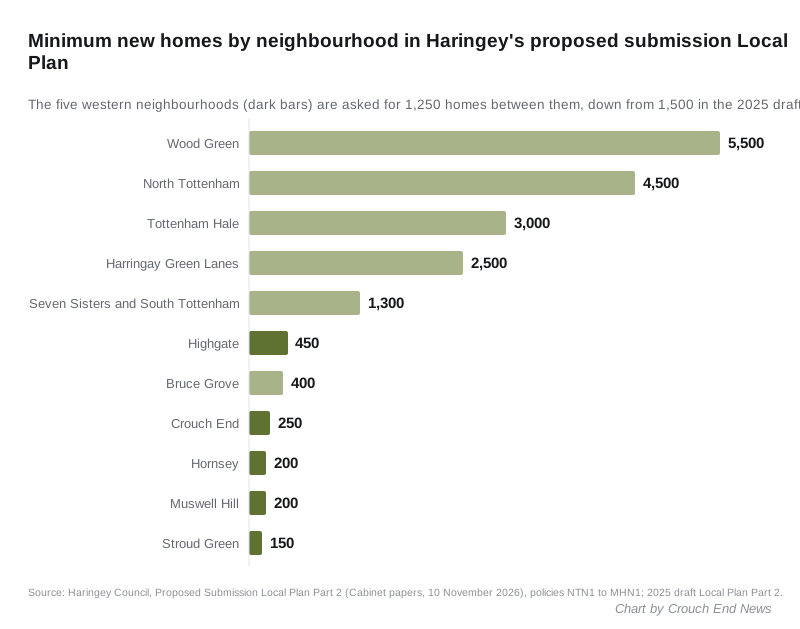
Almost all of the increase lands in the east and in Wood Green. The five western neighbourhoods, Crouch End, Hornsey, Muswell Hill, Highgate and Stroud Green, are now asked for 1,250 homes between them, down from 1,500 in the draft.
The Local Plan decides what can be built where. Once adopted, planning applications are judged against it. This is the version the council intends to adopt, and it is the last chance for residents to comment before a government inspector examines it.
What changes in the west
The minimum for each neighbourhood is set in its own policy in Part 2 of the Proposed Submission Local Plan. Comparing them with the 2025 draft:
| Neighbourhood | 2025 draft | Proposed submission |
|---|---|---|
| Highgate | 400 | 450 |
| Crouch End | 250 | 250 |
| Hornsey | 250 | 200 |
| Muswell Hill | 250 | 200 |
| Stroud Green | 350 | 150 |
| Total | 1,500 | 1,250 |
The east goes the other way. Wood Green rises from 4,500 to 5,500, North Tottenham from 4,000 to 4,500, Tottenham Hale from 2,500 to 3,000, and Seven Sisters and South Tottenham from 1,200 to 1,300. Bruce Grove (400) and Harringay Green Lanes (2,500) are unchanged.
The sites that were dropped or changed
The Cabinet report lists the main changes since the draft. Those affecting our area are:
- Pinkham Way protected for nature. Its employment land designation is removed and the site gets a new open space designation. The Cabinet member’s introduction says its “primary purpose should be biodiversity recovery, public enjoyment of nature and ecological stewardship”.
- Rowans Bowling Alley removed as a development site. The report says about 7,000 consultation responses, around 70% of the total, were about Rowans.
- Summerland Gardens car park removed. The council’s consultation report says it was deleted “having regard to consultation feedback” about the loss of parking for Muswell Hill Broadway. The Muswell Hill Car Park and 5-7 Fortis Green site stays in, with an indicative 15 homes.
- Hornsey Filter Beds scaled back. The 3.2 hectare site off Newland Road is now allocated for “heritage and nature-led restoration”, including a publicly accessible wetland. Only “limited enabling residential development” would be allowed, and only where it pays for those public benefits. The consultation report says the Hornsey Historical Society and others objected to the scale of housing in the draft.
- Biodiversity net gain raised to 20% on schemes that must provide it.
Crouch End’s seven sites
Crouch End’s 250 is unchanged, but the list of named sites has grown from six to seven. The new one is YMCA Crouch End at 184 Tottenham Lane. It is allocated for a rebuilt hostel and supported housing for young people experiencing homelessness, with 174 bedspaces, in buildings of about four to seven storeys. It is phased for 2027 to 2031, the earliest of any Crouch End site.
The other six are the sites in the draft, with some dates moved:
| Ref | Site | Indicative capacity | Phasing (draft) |
|---|---|---|---|
| CE SA01 | Former telephone exchange, Crouch End Hill | 40 homes | 2033-2037 (2032-2036) |
| CE SA02 | 139-143 Crouch Hill | 10 homes | 2033-2037 (2037-2041) |
| CE SA03 | 156 Tottenham Lane | 30 homes | 2038-2042 (2037-2041) |
| CE SA04 | YMCA Crouch End, 184 Tottenham Lane | 174 hostel bedspaces | 2027-2031 (new) |
| CE SA05 | 93-113 Park Road | 50 homes | 2033-2037 (2037-2041) |
| CE SA06 | Lynton Road depot and 72-96 Park Road | 90 homes | 2028-2042 (2027-2041) |
| CE SA07 | Ramsey Court, Park Road | 9 homes | 2028-2032 (2027-2031) |
The six housing sites still add up to 229 homes, short of the 250 minimum, so the rest is expected from smaller schemes and conversions. Our Crouch End planning page explains each site.
When you can comment
The Cabinet is asked to recommend the plan to Full Council on Monday 23 November. The report says the consultation “will begin shortly after” that meeting and will last at least six weeks.
The council’s updated Local Development Scheme sets out the rest of the timetable:
- December 2026 to January 2027: consultation on the proposed submission plan.
- March to September 2027: submission to the government and examination by a planning inspector.
- March 2028: adoption.
The last published timetable, from March 2025, had the plan adopted in February 2027.
What it means for you
This consultation is not a fresh start. The Cabinet report says comments should be about whether the plan is “legally compliant and sound”, and that it “is not intended to revisit earlier plan-making options”. Every response goes to the inspector.
So if you objected to a site in 2025, check what has changed before you write again. If a site you care about is still in, the inspector will want to know why the plan is not justified or will not work, not simply that you oppose it.
Until the new plan is adopted, applications in Crouch End are decided under the 2017 Local Plan. Applications can be searched and commented on through Haringey Council’s planning applications pages.
Sources
- Haringey Council: Cabinet, 10 November 2026, agenda and papers
- Cabinet report: Regulation 19 consultation on the Proposed Submission Local Plan
- Appendix A: Local Development Scheme, November 2026
- Appendix B: Draft Local Plan consultation report
- Appendix C: Proposed Submission Local Plan Part 1 and Part 2
- Haringey draft Local Plan Part 2, October 2025
Have your say