
Hornsey School for Girls got 71% to grade 4 in English and maths, down from 75%. Highgate and Channing published too. The council published no figures.
Haringey pupils got their GCSE results on Thursday 20 August. Two days on, three schools in and around Crouch End have published figures. The council has published none.
Its results day release runs to about 450 words, congratulates every pupil in the borough, and describes the Leader’s visit to Gladesmore Community School in South Tottenham. It contains no percentage, no grade profile and no comparison with any previous year.
The council’s A level release a week earlier at least carried one number, a London-wide 32.7% of entries at A* or A. The GCSE release carries none, so the schools themselves are the only source of figures this week.
Here is what each of the three actually published, and what each number can fairly be compared with. That last part matters more than it sounds, because the three are measuring different things.
What the three schools published
- Hornsey School for Girls (state, Hornsey N8): 71% of pupils reached grade 4 or above in both English and maths. Attainment 8 of 48.10. 50% got grade 5 or above in both. 36% studied the EBacc, with an average point score of 4.16. 97% went on to education, employment or training.
- Highgate School (independent, Highgate N6): from a cohort of 182 pupils sitting 1,785 exams, 96.2% of all grades were 7, 8 or 9, 86.6% were 8 or 9, and 61.7% were grade 9.
- Channing School (independent, Highgate Hill): 85% of all results at grades 7 to 9, 65% at 8 to 9 and 37% at grade 9. 55% of the year group got a full set of grades at 7 to 9.
Those figures cannot be put in a table together, and any outlet that does so is misleading you.
Hornsey’s number counts pupils, and it counts a pupil only if they cleared grade 4 in English and in maths. Highgate’s and Channing’s count individual results, across every subject a pupil sat. A school where every pupil takes ten subjects will always look different on the second measure than on the first. They are not better or worse numbers, they are different questions.
Hornsey School for Girls: strong locally, down on last year
Hornsey School for Girls published the fullest breakdown of the three, and it is the only one on a basis the Department for Education also publishes for the borough, the region and the country. That makes it the only one that can be checked against anything.
The school’s own three-year table gives 70% in 2024, 75% in 2025 and 71% in 2026. So the headline is a four point fall from last year, to a level slightly above where the school was two years ago.
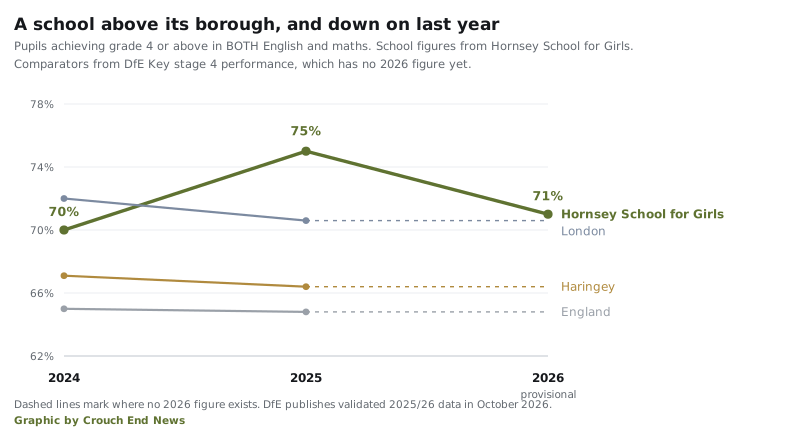
The school’s news post says it “retained attainment above the national average”. On the most recent validated national figure that is correct, and by a wide margin. Here is the ladder, from DfE Key stage 4 performance:
| Area | 2023 | 2024 | 2025 | 2026 |
|---|---|---|---|---|
| Hornsey School for Girls | Not published | 70 | 75 | 71 |
| London | 71.2 | 72.0 | 70.6 | Not yet published |
| Haringey | 65.9 | 67.1 | 66.4 | Not yet published |
| England | 65.1 | 65.0 | 64.8 | Not yet published |
Two things follow from that table.
The school is comfortably ahead of its borough. Haringey as a whole was 66.4% in 2025 and has not been above 67.1% in three years. Hornsey School for Girls was 75% in 2025 and 71% now. On the last year where both figures exist, the school was 8.6 points ahead of the borough average.
There is no 2026 national figure to compare with yet. DfE does not publish validated Key stage 4 data for this summer until October 2026. Any comparison made this week, by any school or any newspaper, is against last summer’s national result. The school’s 2026 figure is also marked provisional and unvalidated on its own page, which is the honest label for it.
The subjects that moved
The school publishes grade 9 to 5 rates by subject for three years running, which almost no school does and no council does at all. The swings are large in both directions:
| Subject | 2024 | 2025 | 2026 |
|---|---|---|---|
| French | 65 | 61 | 79 |
| Art | 69 | 56 | 74 |
| Biology | 78 | 79 | 75 |
| History | 64 | 76 | 71 |
| English Literature | 68 | 70 | 65 |
| English Language | 67 | 60 | 62 |
| Chemistry | 64 | 78 | 61 |
| Physics | 58 | 69 | 59 |
| Maths | 50 | 53 | 54 |
| Geography | 63 | 69 | 50 |
| Spanish | 81 | 61 | 50 |
| Computer Science | 55 | 35 | 25 |
French is up 18 points in a year and art is up 18. Maths has risen in each of the three years, from 50% to 54%. Going the other way, geography is down 19 points, Spanish has halved from 81% to 50% over two years, and computer science has fallen in both years, from 55% to 25%.
A word of caution on all of those. These are single year groups in one school, and some of these subjects will be taken by only a handful of pupils, so a couple of results can move a percentage a long way. The school does not publish entry numbers by subject, so the swings cannot be weighted.
Headteacher Kuljit Rahelu said the school was “immensely proud of all students of all capabilities who have all achieved the grades they need for their next steps”, and pointed to the effect of “the move to numerical grading and concentrated periods of intensive exam scheduling” on pupils’ wellbeing.
The two independents, against the right benchmark
Highgate and Channing report the share of results at the top grades, so the fair comparator is Ofqual’s national figure on the same basis. Ofqual published it on results day:
| Group | Grade 7 or above |
|---|---|
| Highgate School | 96.2 |
| Channing School | 85.0 |
| London, 16-year-olds | 30.2 |
| England, 16-year-olds | 23.1 |
| London, all ages | 28.6 |
| England, all ages | 21.8 |
Use the 16-year-old rows. The all-ages figures are pulled down by resits taken at colleges, which a school’s Year 11 cohort has none of.
Both schools are selective and fee-charging, so the gap is not a like-for-like measure of teaching. It is still worth publishing, because the numbers are so often quoted without any national figure beside them at all.
At Highgate, Head Adam Pettitt noted the cohort sat “exams in ten subjects and an exam spell which lasts six weeks”. At Channing, Headmistress Lindsey Hughes said the results were “the direct result of their hard work and dedication”. Channing reported more than 85% of results at grades 7 to 9 in biology, chemistry, drama, English, geography, Latin, maths, music, physics and Spanish, and 100% at 7 to 9 in German and PE.
What we could not get
We checked every secondary school in the Crouch End, Muswell Hill, Hornsey and Highgate area. As of Saturday 22 August, these had not published 2026 GCSE figures:
- Fortismere School, Muswell Hill. Its homepage carries a results panel, but the GCSE counters were not showing figures, and
/results/returns a 404. - Alexandra Park School, Wood Green. It has a GCSE results page, but the page returns a server error rather than content.
- Highgate Wood School, Crouch End. Nothing on its news pages.
- Greig City Academy, Hornsey. Nothing on its news feed.
None of that means those schools did badly. Publishing on results day is a choice about communications, not a measure of performance, and several will put figures up when the term starts. We will add them here when they do.
What it means for you
If your daughter or son wants a paper re-marked, the date is 24 September. The JCQ deadline for a review of marking on a GCSE, and for access to scripts, is 24 September 2026. The priority service with the 20 August deadline was for A levels and Level 3 qualifications only, so it does not apply here. Requests go through the school, not to the exam board directly, and a review can move a grade down as well as up.
If you are comparing schools, wait for October. Every figure published this week is provisional and unvalidated, and each school has chosen its own measure. The DfE’s validated Key stage 4 data for summer 2026, on one basis for every school in the country, is due in October 2026. Until then the compare school performance service holds last year’s validated figures, which is what admissions decisions should still be read against.
If you are choosing a secondary school this autumn, note that applications for Year 7 close before the validated results come out. Check the closing date with Haringey school admissions, and judge schools on the 2025 validated data rather than on this week’s headlines.
Related
- A level results 2026: Haringey schools: the same sweep a week earlier, when the council did publish a release naming figures.
- Crouch End house prices: what homes in the catchments actually sell for.
- Crouch End roadworks and travel: including the Shepherds Hill works booked for the week schools go back.
Sources
- Joyous Haringey students shine bright on GCSE Results Day, Haringey Council, 20 August 2026, read in full for the absence of any figures and for the Gladesmore visit.
- Exam Results 2026 and Results Breakdown, Hornsey School for Girls, for the 71%, the Attainment 8 of 48.10, the EBacc figures, the three-year subject table and the provisional label. The head’s quotes come from the school’s results day news post.
- GCSE Results 2026, Highgate School, for the 182 pupils, 1,785 exams, 96.2% at 7 to 9, 86.6% at 8 to 9 and 61.7% at grade 9.
- Channing girls enjoy outstanding 2026 GCSE success, Channing School, for the 37% at grade 9, 65% at 8 to 9, 85% at 7 to 9 and the departmental figures.
- Qualification results in England: summer 2026, Ofqual, tables 19a and 19b, for the England and London figures at grade 7 and above, all ages and 16-year-olds.
- Key stage 4 performance, Department for Education, queried through its statistics API, for the percentage of pupils achieving grade 4 or above in English and maths in Haringey, London and England for 2022/23, 2023/24 and 2024/25.
- Post-results services, JCQ, for the 24 September 2026 deadline and the qualifications the 20 August priority service covers.
We do not name pupils. Schools’ own figures are chosen and presented by the schools themselves and are not comparable with each other. All 2026 figures are provisional until the DfE publishes validated data in October.
Have your say